The afternoon light cuts through the blinds, casting parallel shadows across your home office. You press the small plastic button on the edge of your desk, listening to the mechanical whir as the heavy wooden surface rises smoothly to your waist. It feels like a small victory over the sedentary trap that has claimed so many professionals.
You push your ergonomic chair aside, plant your bare feet firmly on the cold laminate floor, and prepare to conquer the rest of your afternoon inbox. You expect immediate physical relief, convinced that simply standing up is the perfect antidote to the dull, persistent ache in your lower back.
But within forty-five minutes, a tight, burning sensation begins to pool right at the base of your spine. Instead of fixing the problem, you have inadvertently traded one form of structural collapse for another. Standing perfectly still on a rigid surface without a proper buffer forces your delicate lumbar discs to absorb every single ounce of your body weight.
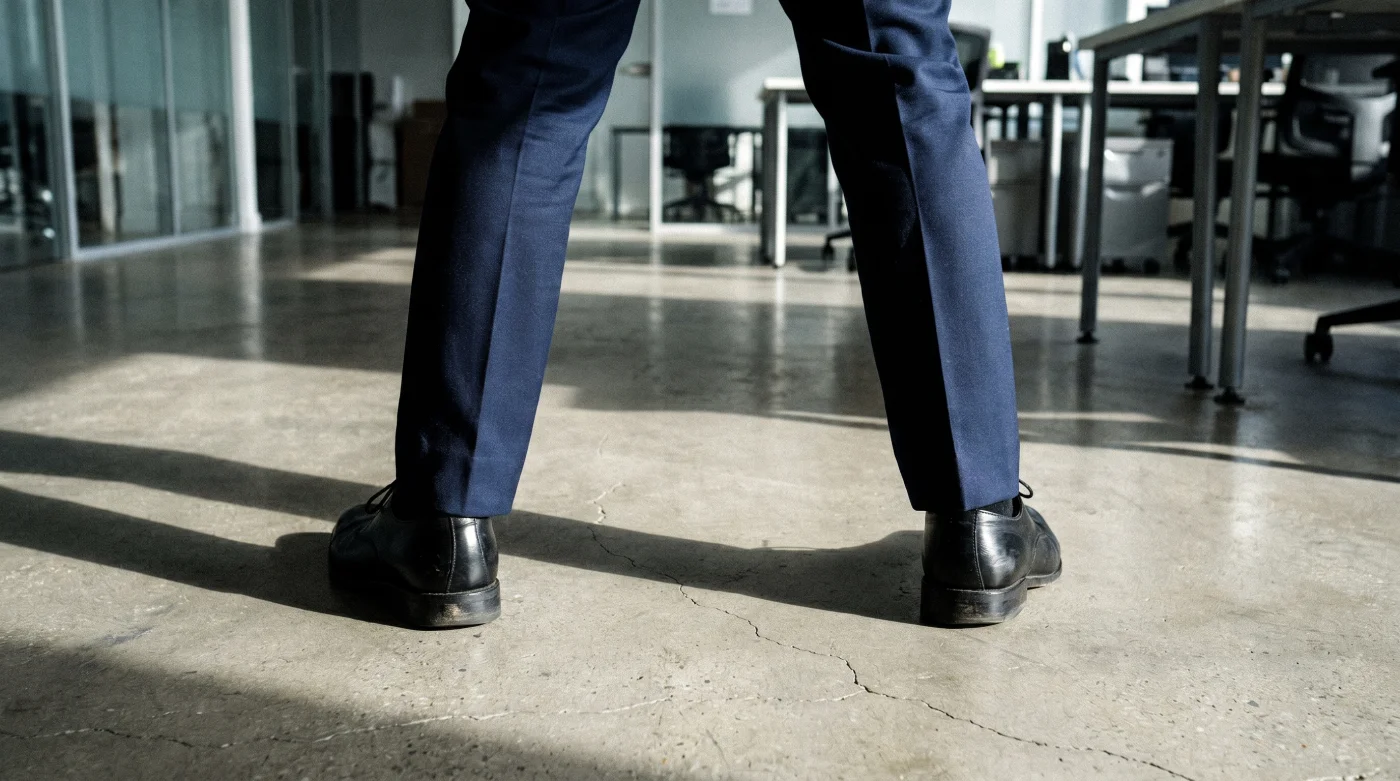
When you lock your knees on hardwood, tile, or even thin carpet, your skeleton acts like a building without a foundation, transmitting the harsh shock of gravity straight up through your heels. Your lower spine deteriorates faster because it is suddenly forced to do the heavy lifting that your neglected leg muscles and feet were designed to handle natively.
The Concrete Trap and the Shock Absorber Myth
Think of your body as a high-performance vehicle. You would never dream of driving a luxury car without tires, grinding the bare metal rims directly against the rough asphalt of the highway at sixty miles per hour. Yet, this is exactly what happens when you pair a thousand-dollar motorized workstation with an unforgiving floor surface.
The mistake lies in assuming that standing is a completely passive activity. When your feet meet a hard surface, the vital micro-movements that naturally lubricate your joints simply stop functioning. Your posture becomes defensively rigid, locking the knees backwards and tilting the pelvis forward to artificially balance the heavy load of your torso.
This seemingly mundane detail—the actual floor beneath your socks—holds the key to a massive physical advantage. Introducing an anti-fatigue mat creates a layer of deliberate, calculated instability. A dense, yielding surface forces your calves, ankles, and toes to make continuous imperceptible adjustments, pumping fresh blood and keeping the lower back incredibly loose.
- Noise-canceling headphones degrade auditory awareness during critical remote team meetings
- Resume paper texture causes errors in automated applicant scanning machines
- Cubicle walls originally aimed to increase freedom for corporate employees
- Ergonomic mice eliminate the wrist strain slowing down spreadsheet navigation
- Security badges track employee desk time during annual salary negotiations
Consider the recent findings of Marcus Thorne, a forty-eight-year-old occupational kinesiologist based in Chicago. Two years into the massive global shift to remote work, his clinic was flooded with professionals suffering from sharp, highly localized lower back pain. He realized that while his patients had all purchased beautiful motorized standing desks, they were almost entirely standing barefoot on kitchen tile or concrete loft floors. Marcus prescribed specific polyurethane mats instead of generic muscle relaxers, noting that a yielding floor surface forced physical micro-movements that quickly restored the spine’s natural curvature.
Adjusting Your Physical Foundation
Not all floor buffers are created equal, and your specific workspace dictates the exact type of physical support you need. The density of the foam must perfectly match the way you naturally move through your workday.
For the Barefoot Minimalist: If you strongly prefer working without shoes, you need a mat engineered with a smooth polyurethane outer layer and a solid gel core. A standard memory foam mat will bottom out under the sharp pressure of your heels within twenty minutes, leaving you standing right back on the hard floor underneath.
For the Restless Pacer: If you take phone calls by constantly shifting your weight from side to side, a flat rectangular mat severely limits your natural range of motion. Look for a topographic mat featuring raised edges, massage mounds, and textured corners.
These subtle terrain shifts keep your arches actively engaged throughout the morning. Preventing static knee locking is the only reliable way to stop crushing your delicate lumbar discs during a two-hour virtual conference call.
For the Thick Carpet Dweller: Placing a soft foam mat directly over plush bedroom carpet creates a dangerous, unstable hammock effect. Your heels will sink significantly lower than your toes, severely hyperextending your knees backward over time.
In this specific scenario, you need an extra-firm core beneath your feet. Use a rigid balance board or a hard-backed topographic mat to maintain a perfectly neutral ankle position without sinking endlessly into the floorboards.
The Mindful Stance Framework
Correcting your workspace fatigue requires a few deliberate, minimalist adjustments to your daily routine. Simply dropping a thick piece of foam on the floor is not enough if your body mechanics remain rigidly trapped in their old, damaging patterns.
Approach your standing intervals with clear intention. Keep your knees slightly soft at all times, almost as if you are gently preparing to catch a heavy object thrown your way. Shift your weight constantly to keep your stabilizer muscles actively firing.
- Set your desk height so your elbows rest at a perfect ninety-degree angle, preventing your heavy shoulders from rolling forward and pulling your spine completely out of alignment.
- Place one foot slightly ahead of the other, mimicking the mechanics of a slow walking stride, to evenly distribute the physical load across different muscle groups.
- Limit your continuous standing periods to exactly forty-five minutes; your body physically thrives on the transition between different postures, rather than holding a single pose indefinitely.
Tactical Toolkit: Aim for a mat thickness of exactly three-quarters of an inch. Any thinner impacts the floor, while anything thicker causes you to lose necessary structural stability. Keep a small, firm massage ball tucked under the desk to roll out your tense plantar fascia during long reading sessions.
Reclaiming Your Workspace
Healing your workspace fatigue fundamentally changes the way you interact with your entire workday. When you finally stop fighting gravity and start working intelligently with it, the crushing physical friction of the late afternoon completely vanishes.
You stop bracing your body for inevitable pain. That subtle shift from rigid endurance to fluid, actively supported movement protects your joints for decades to come. You reclaim your physical energy, leaving you with the stamina to focus on what actually matters when the screen finally goes dark.
A truly supportive workspace environment doesn’t just hold your weight; it actively encourages your musculoskeletal system to keep moving.
| Key Point | Detail | Added Value for the Reader |
|---|---|---|
| Flat Floor Standing | Locking knees on rigid surfaces. | Identifies the hidden cause of your sudden lumbar pain. |
| Gel-Core Support | Three-quarter-inch polyurethane foam padding. | Eliminates bottoming out, protecting your heels and lower back. |
| Active Staggering | Placing one foot ahead of the other. | Prevents static joint load and encourages healthy blood flow. |
Workspace Support FAQ
Why does my back hurt more since I started standing?
You are likely locking your knees on a rigid floor, which completely bypasses your leg muscles and forces your lower spine to absorb all your body weight.Can I just use thick socks or running shoes?
Shoes help slightly, but they do not provide the broad, active instability of an anti-fatigue mat that forces healthy micro-movements in your calves.How long should I stand at one time?
Aim for intervals of roughly thirty to forty-five minutes. The true physical benefit comes from the transition between sitting and standing, not from holding one position all day.Are all foam mats the same?
No. Standard kitchen mats often use low-density foam that compresses completely under human weight. You need a solid gel or high-density polyurethane core to maintain structural integrity.What if I work on carpet?
Placing a soft mat on soft carpet throws off your balance. Use a firmer mat or a rigid wooden balance board to maintain proper heel alignment.