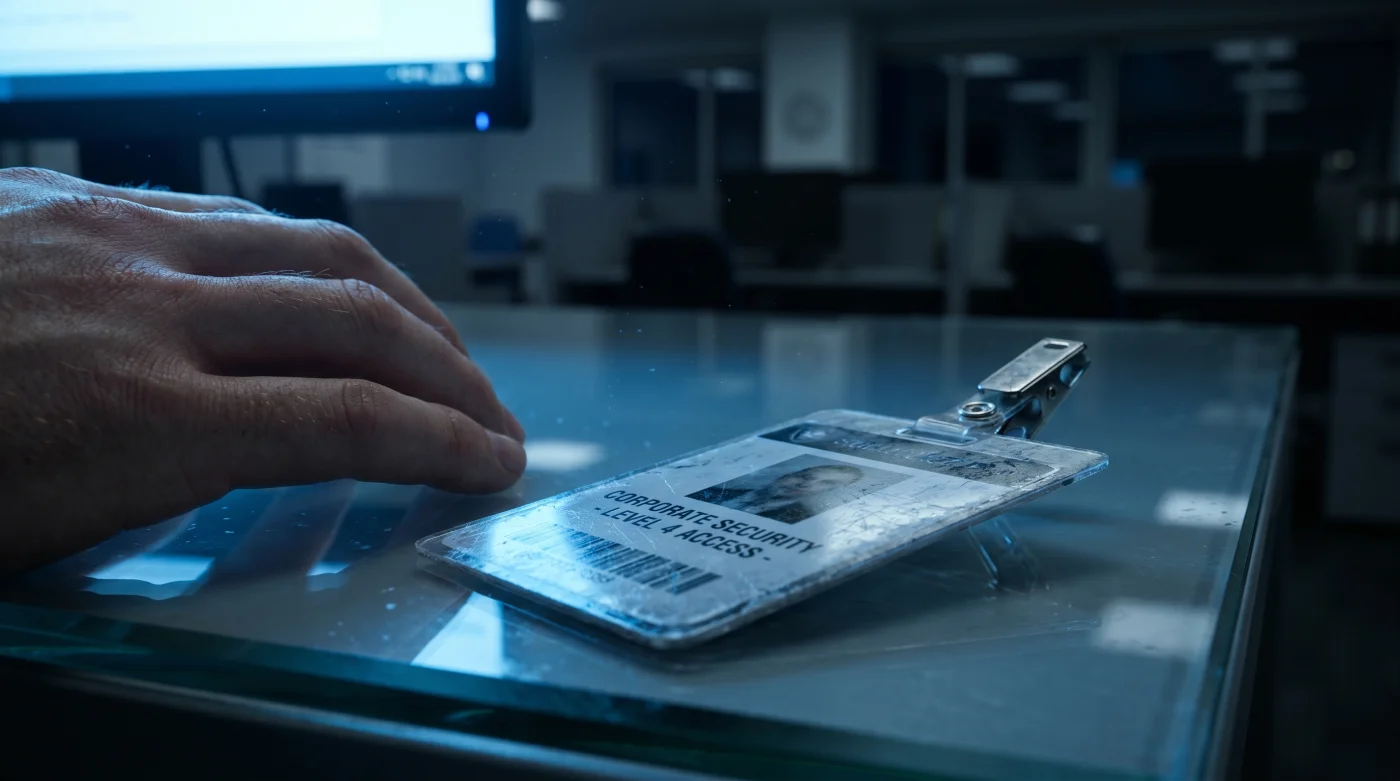
The morning always starts the same way. The heavy glass doors of the lobby part, carrying the faint scent of rain-dampened wool and over-roasted espresso. You fish the plastic rectangle from your bag, press it against the black scanner, and wait for that familiar, hollow chirp. It feels like an ordinary Tuesday ritual, the simple act of opening a door.
But that chirp is quietly doing much more than granting you access to the elevator bank. It writes your performance narrative. While you boot up your laptop and start sifting through morning emails, a quiet database is cataloging exactly how long your physical body remains inside the corporate perimeter. You assume your worth is measured by the clarity of your spreadsheets and the calmness of your client calls.
The reality is far more mechanical. In the months leading up to annual reviews, human resources departments across the country are quietly pulling access logs. They are searching for a very specific metric: the variance between expected desk time and actual badge-recorded presence. When you ask for that top-tier compensation bump, your manager might smile, but the system has already audited your physical footprint.
This is the invisible boundary between securing a meaningful raise and being handed a standard cost-of-living adjustment. Once you understand that the turnstile is a negotiation tool, your entire approach to the workday shifts. You stop just showing up and start managing your spatial data.
The Silent Audit Under Your Lanyard
Think of your office building not as a workplace, but as a giant, breathing sensor. When you leave for a mid-day doctor’s appointment, or step out to grab a salad, the building notes the gap. For years, we operated under the illusion of the honor system. As long as the quarterly targets were hit, the breathing room between nine and five belonged to you.
Now, algorithms process that breathing room. Proximity dictates perceived corporate dedication. The flaw in this logic is obvious to anyone actually doing the work: time spent at a desk rarely correlates to the quality of the ideas generated. Yet, this mundane detail—the exact minute you scan the parking garage gate—has become the primary leverage point when budgets are tight. What feels like a system built to micromanage you is actually highly predictable machinery. Because it only measures physical presence, it is incredibly easy to feed the machine exactly what it wants to see.
Marcus Thorne, a 42-year-old former compensation analyst for a major Chicago logistics firm, spent a decade running these exact reports. Every October, his team would aggregate access data, flagging employees whose in-office hours fell below the seventy-fifth percentile. “It was never about catching someone stealing time,” Marcus explains. “It was a filter. If we had ten people fighting for three top-tier bonus slots, the badge logs gave us a quantifiable reason to deny the bottom seven. It was emotionally detached math.”
Reading Your Own Digital Footprint
Understanding how your movement is tracked allows you to adapt. Map your specific working style. The moment you map your habits against the system, your perceived flaws transform into calculated advantages.
For the hybrid strategist today, the risk is the shortened schedule. You might decide to beat traffic by leaving at three and finishing up from the kitchen island at home. To the system, that registers as a four-hour absence. You must artificially extend your physical footprint on your designated days to compensate for the remote flexibility.
If you fall into the ‘Office Anchor’ category, working five days a week on-site, your risk is different. The system expects absolute consistency. A long lunch or a forgotten badge-in at the side door suddenly looks like an anomaly in an otherwise perfect attendance record, prompting unwanted scrutiny from software designed to flag deviations.
For the frequent campus drifter, the professional who moves between buildings for meetings, the danger is the undocumented void. If you spend three hours in a facility that does not require a secondary scan, the primary database assumes you went home. You have to actively ping the system to prove you still exist within the corporate ecosystem.
Mindful Application and the ‘One Sentence’ Counter-Measure
You do not need to become paranoid; you just need to become deliberate. When you sit down for your annual review, the goal is to preempt the silent audit. You need a single, irrefutable statement that neutralizes the badge data before human resources can use it against you. Secure your leverage right here.
Deploy the pre-emptive anchor now. Before compensation numbers are even discussed, you frame your physical presence deliberately. You look at your manager and state: ‘My workflow this year was designed around maximizing high-impact collaboration during my logged campus hours, which directly facilitated my twenty percent gain in measurable output.’ This is the ‘One Sentence’ Negotiator hack. You claim the data as your personal strategy before they can use it as a penalty.
To ensure your access logs support your negotiation, you must build a routine. Build a weekly tactical toolkit. Follow these specific, minimalist actions to manage your digital footprint effortlessly:
- Scan the primary turnstile every time you enter, even if a colleague holds the door open for you. Office politeness actively ruins your data.
- If you take an off-site lunch, ensure you badge back in at least fifteen minutes before your next scheduled meeting to register a comfortable buffer.
- When moving between non-gated campus buildings, log onto the local Wi-Fi network with your mobile device. IT network pings are frequently merged with badge data to verify active presence.
- Keep your arrival times aggressively consistent. A steady 8:45 AM scan is trusted more by anomaly-detecting software than a fluctuating 8:15 AM to 9:30 AM arrival window.
Designing Your Corporate Presence
There is a strange peace in realizing that the corporate machine operates on such simple, literal terms. When you strip away the emotional weight of proving yourself and view your plastic lanyard as a simple data-entry tool, the anxiety of the office dissolves. You are no longer performing for a hidden audience.
You control the narrative completely. Master the act of badging. You are no longer wondering if your late nights at home are being recognized, because you understand that the game is scored differently. By mastering the mundane act of badging in, you protect your mental energy for the actual work that matters.
Your compensation should be a reflection of your talent, your strategy, and the value you bring to the table. Do not let a silent database dictate your financial worth. By feeding the system exactly what it wants to see, you clear the path to demand the salary you genuinely deserve.
“The most successful negotiators I see aren’t the ones who argue the loudest; they are the ones who understand how the company’s internal metrics are secretly scored.” – Marcus Thorne
| Key Point | Detail | Added Value for the Reader |
|---|---|---|
| The Silent Audit | HR uses badge scans to calculate desk time before performance reviews. | Removes the shock of a denied raise and provides a clear target to manage. |
| The One-Sentence Hack | Pre-framing your presence as a ‘disciplined on-site strategy’. | Disarms HR’s primary filtering tool and puts you in a position of power. |
| Digital Consistency | Scanning consistently, even when doors are open, to build a steady log. | Ensures your digital footprint matches your actual dedication without extra effort. |
Frequently Asked Questions
Can my employer legally track my security badge? Yes. In the US, corporate access systems and the data they generate are company property, used for security and operational analytics.
Do they look at my badge data every single day? Rarely. Analytics software usually runs in the background, flagging anomalies or compiling aggregate scores during quarterly and annual review cycles.
Does staying late compensate for arriving late? Not always. Many access systems value consistency over total duration. A fluctuating arrival time often triggers an anomaly flag faster than a slightly shorter, strictly regimented day.
Should I use the ‘One Sentence’ hack if my data is already perfect? Absolutely. It reinforces that your perfect attendance is a deliberate professional strategy, not just a habit.
What if I work in a building with no turnstiles? If your building lacks physical barriers, HR often pulls data from Wi-Fi access point handoffs. Connecting to the corporate network via your phone or laptop acts as your digital badge.