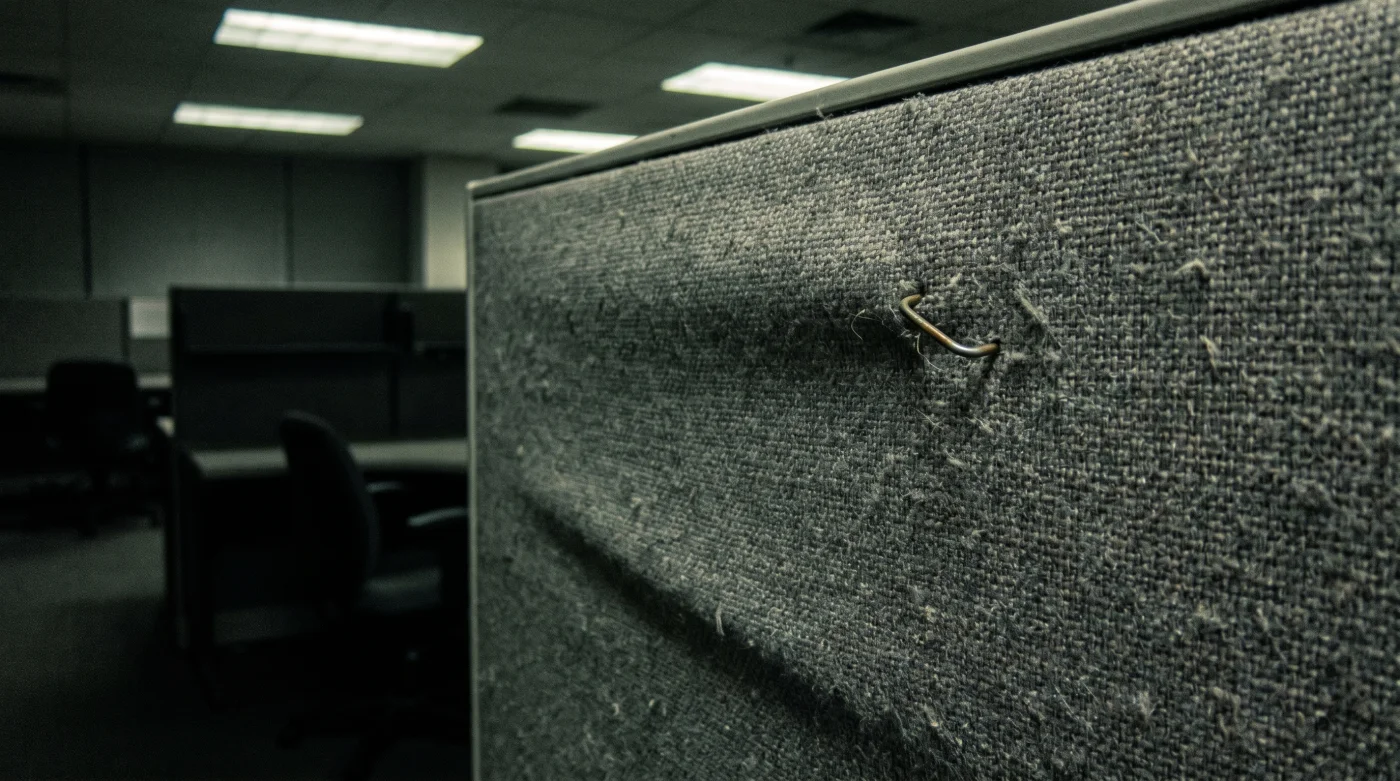
You run your fingers over the rough, gray weave of the partition beside your monitor. The muffled hum of fluorescent lights mixes with the distant clicking of a mechanical keyboard and the hushed tones of a status call two rows over. It is the universal, often exhausting soundtrack of the American workday. You likely view these padded boundaries as the ultimate corporate prison, a physical manifestation of bureaucratic monotony designed to keep you seated, silent, and producing.
Yet, if you peel back the layers of mid-century corporate history, a completely different reality emerges. The original fabric partition was never intended to be a cage. It was actually conceived as a radical instrument of professional rebellion. Before these fabric walls existed, the standard office environment was a sprawling, terrifying expanse of forced visibility that drained the energy of anyone who sat within it.
Imagine walking into a room where two hundred metal desks sit in perfectly aligned, rigid rows. There are no walls, no potted plants to break the eyeline, no personal photos, and absolutely no place to hide. This was the traditional bullpen of the early twentieth century. Managers sat in glass-walled perimeter offices, looking down on the floor like wardens overseeing a typing factory. The noise was deafening, the air felt stagnant, and the psychological pressure of constant, unending surveillance was unrelenting.
By the time the 1960s rolled around, industrial researchers realized this setup was actively destroying human vitality. A lack of visual privacy drained focus and left workers feeling entirely exposed to the whims of upper management. The introduction of the first modular office partitions was specifically meant to break up those rigid rows and give individuals a sliver of sovereignty over their daily tasks. They were built to set you free.
The Geometry of Liberation
We often misunderstand the intentions of industrial design because we only experience the corrupted, cost-cutting versions of the original ideas. The transition from the open bullpen to the modern cubicle was supposed to mimic the natural flow of human interaction. Think of it like organizing a bustling professional kitchen; you need distinct stations for prep, cooking, and washing, rather than throwing every chef around a single, massive table and expecting quiet efficiency.
The fabric wall acts as a sensory filter. Operating in a completely open office is like trying to breathe through a pillow—the raw volume of stimuli constantly suffocates your focus. It dampens acoustic chaos, absorbing the sharp spikes of ringing phones and loud talkers, allowing your nervous system to rest. When you understand this architectural system, you stop seeing the partition as a mechanism of isolation and start recognizing it as a vital boundary against an overwhelming environment. The perceived visual restriction is actually your greatest professional advantage.
In 1968, a brilliant researcher and designer named Robert Propst sought to cure the physical ailments of the open office. Working for the Herman Miller furniture company, Propst studied how people actually moved, thought, and collaborated. He recognized that office workers were quietly withering in the traditional bullpen. In response, he created the ‘Action Office,’ a vibrant, highly adjustable system of interlocking panels set at obtuse 120-degree angles rather than rigid squares.
Propst’s original vision was a fluid, breathing workspace. His panels provided acoustic shelter while remaining low enough to allow a worker to stand, stretch, and see their colleagues. The space was meant to be heavily customized by the individual, featuring varied desk heights to encourage standing throughout the day. It was an ecosystem of autonomy, a far cry from the beige boxes that eventually flooded corporate real estate when facility managers prioritized density over human comfort.
The Anatomy of Modern Enclosures
Today, we are witnessing a quiet return to the principles of partitioned work, though the applications vary wildly across different sectors. After a decade of entirely open-plan offices that proved disastrous for sustained focus, smart companies are reintroducing fabric walls to solve the friction of modern, multi-tasking distractions.
For the Deep Worker, the enclosure is about sensory deprivation in the best possible way. Tall, thick acoustic boundaries wrap around the desk, creating a micro-environment where complex spreadsheets, heavy coding, or technical writing can happen without the constant peripheral threat of someone walking past. Here, the fabric wall acts exactly like noise-canceling headphones for your peripheral vision.
For the Collaborative Pod, the partitions serve a completely different master. Rather than isolating an individual, these lower, rolling walls corral a team of three or four into a shared tactical space. They can pin architectural blueprints, mood boards, or project timelines directly to the fabric, using the boundary not as a wall, but as a shared canvas that flexes as their project evolves over the quarter.
Then there is the Hybrid Drifter, the professional splitting days between the kitchen table and the corporate hub. Temporary desk dividers allow for rapid, necessary context switching. When you slide into a hot-desk, pulling a small, felted partition around your laptop immediately signals to your brain that you have transitioned from the vulnerability of the open room into a secured zone of professional execution.
Reclaiming Your Fabric Perimeter
You do not have to accept the default, lifeless configuration of your workspace. Modifying your immediate environment actively reduces physical fatigue and re-establishes the personal autonomy that Robert Propst originally intended for you. Taking control of your corporate square footage requires just a few mindful, minimalist actions.
The goal is to manipulate the light, sound, and sightlines to serve your nervous system rather than fighting against it. Adjusting your physical anchors transforms the space from a generic gray box into a highly tailored cockpit. Follow these exact steps to optimize your partitioned space:
- Rotate your primary monitor so your back is not directly facing the opening of your workspace; seeing the entrance drastically reduces low-level nervous anxiety.
- Pin soft, highly textured materials—like a small wool mat or a thick cork board—to the walls directly at your ear level to further deaden high-frequency office chatter.
- Introduce a dedicated, low-wattage task light to create a pool of warm illumination on your desk, effectively washing out the harsh, overhead fluorescent glare.
- Utilize your vertical space by lifting physical paperwork off the desk and pinning it to the fabric walls, completely clearing your immediate horizontal visual field.
Your Tactical Toolkit for this transformation is remarkably simple.
You need a directional desk lamp equipped with a 3000K LED bulb, an adjustable monitor arm to elevate your screen perfectly to eye level, and a set of high-density felt acoustic panels. These specific physical modifications dictate how your body physically responds to the space, easing the strain on your neck and eyes over an eight-hour shift.
Finding Solace in the Square
Coming to terms with the fabric partition changes how you navigate your entire career environment. It is incredibly easy to resent the beige walls when you view them as a symbol of corporate control or a lack of trust. But when you reframe them as a tool of personal defense—a localized shield against the exhausting demands of constant availability—you immediately reclaim your daily energy.
Mastering your immediate physical environment is the very first step in setting firm professional boundaries. Your physical space dictates your mental capacity and your stress tolerance. A well-managed enclosure allows you to leave the chaos of the company floor at the threshold of your desk, giving you the mental quiet required to actually do the work you were hired to do without burning out by Thursday afternoon.
The next time you sit down, sip your morning coffee, and look at that rough, gray weave, remember that it is not there to keep you locked in. It is there to keep the noise of the world out.
The office partition was never designed to be a cage; it was engineered to be a sanctuary, giving the individual the acoustic and visual privacy necessary to hear their own thoughts amidst the machinery of industry.
| Key Point | Detail | Added Value for the Reader |
|---|---|---|
| The 1950s Open Bullpen | Endless rows of exposed metal desks with zero privacy or acoustic dampening. | Helps you understand exactly the overwhelming surveillance the modern partition protects you from. |
| The 1968 Action Office | Customizable, 120-degree angled fabric walls designed to encourage movement and standing. | Provides a template for how you should be modifying your own space to prioritize personal autonomy. |
| Modern Corporate Cubicles | Rigid, cost-saving 90-degree boxes that prioritize density over human comfort. | Validates your physical frustration and highlights why you must manually adjust your workspace. |
Common Frustrations, Answered
Why does my cubicle make me feel so tired by the afternoon?
The harsh overhead fluorescent lighting and the acoustic strain of filtering out background noise exhaust your nervous system. Introducing warm task lighting and adding sound-absorbing textures to your walls will immediately reduce this fatigue.Am I allowed to pin things to the fabric walls?
Yes, those walls are specifically manufactured with a porous fabric over an acoustic core designed exactly for pinning. Utilizing this vertical space clears your desk and reduces visual clutter.How can I make a standard gray partition feel less depressing?
Focus on contrast. Bring in a small, low-light desk plant like a Pothos, use a warm-hued desk lamp, and pin a few items with rich, saturated colors to break up the monochromatic gray.What is the best way to handle loud talkers over the wall?
While you cannot control your neighbors, placing high-density felt panels on the shared wall at ear level absorbs a surprising amount of vocal frequency before it reaches you.Does standing up in a cubicle actually help focus?
Absolutely. The original 1960s design was built precisely to encourage shifting between sitting and standing, which increases blood flow and breaks the physical monotony of the enclosure.